Saturday, October 19, 2013

Penne with Tomato, Bacon, and Cheese Sauce (Backlog)

I’ve fallen a bit behind here.

I made the penne recipe on Thursday.  Debbie had just gone away (again!  Is there no balm in Gilead for her travel?) and I searched in Epicurious for “feta and bacon”.  Scratching my salt itch, to put it mildly.

20131017_202038

It went well, and certainly looked normal.  And, since there was no one but me, criticism and self-criticism was a bit attenuated.

Crit Self-Crit

For all the forbidden pleasures of salt I was expecting, it was a bit bland.  Somehow the penne outweighed (in the flavor sense of course) the bacon and feta.  Or maybe it was the tomato; tomato can smother most anything.

Anyhow, nice comfort meal

Stir-fried Shrimp and Vegetables (Backlog)

On a previous Debbie trip, I made stir-fried shrimp and vegetables.  No recipe, just Crummy improv.  Of all the things I make or have made, I’m most comfortable with stir-fried dishes.  It’s because years ago I got a book from a Chinese expat in Canada who described the theory of stir-fried.

Give the Crummy Cook a theory, and he knows what to do: apply it in variations.  Give him a set of instructions, and he’s just intimidated.

Here’s the mise, or the bulk of it.

20131011_201246

Here’s the ensemble in the wok.

20131011_203116

And here it is in the plate.

20131011_203125

Criticism and Self-criticism

None.  I do it pretty well.

Thursday, October 17, 2013

Why Marketing and Engineering Don’t Understand One Another

The inner workings of the tension between Marketing and Engineering are similar to the tension between management and tech staff discussed in my last post.  Similar, but different.

Safe to say that the two don’t understand one another, but the twin elements of unpredictability and needing one another are absent.  And there is a new element: Marketing and Engineering each think what the other does is magic.

Let’s take these one at a time:

  • Unpredictability.  Marketing and Engineering don’t trust one another, but that’s not the same as finding the other unpredictable.  “Those weasels from Marketing, they always do this.”  “You know Engineering will throw up their hands.”  We know what the Other is going to do, we just don’t like it.
  • Needing One Another.  Management wishes we believed we need one another, but in fact neither of us is giving the other a paycheck or the wherewithal for a paycheck, except in a very abstract and attenuated sense that makes no impact on our feelings for one another.  Part of the very tension between the two stems from the fact that there is no urgency to try to work with the other side.  We can fold our arms – and do – and wait for steam to come out of their ears.
  • Magic.  Probably the most interesting of these points.  Marketing has no idea of how software or hardware or even physics works.  To them, everything Engineering does is essentially magic (per Arthur Clarke’s Law #3: “Any sufficiently advanced technology is indistinguishable from magic.”  And, on the other side, Engineering has no idea of how to persuade markets to value or like things; the idea of persuasion in Engineering is that you present your listeners with a fact, and, if they are agree, they are persuaded.  The methods that Marketing uses to involve markets emotionally are magic to Engineering.

One consequence of the “magic” problem is that neither side knows how to assess a promise or a caution from the other side: “We don’t think we can make that schedule” (Why not?  Why not just add more magic?), or “We can’t sell that to soccer moms” (Why not?  Just use your Jedi Mind Tricks on them?).

Understanding the source of the tension between the two groups should help us to talk to one another and, hopefully, break through.

Monday, October 14, 2013

What is the Source of Tension Between Management and Tech Staff?

A first way to approach the divide between geeks and suits is to understand the nature and dynamic of the tension between management and tech staff.

For my money, the heart of it is we need one another but don’t like one another.

From the geek point of view, management is unpredictable.  When you say something to a suit, you have no idea what you’re going to get back: it could be a pat on the cheek; it could be a knife in the back; it could be flattering praise; it could be a curse and a blow; ultimately, it could be a pink slip.

What’s to like for a geek about a system whose output isn’t predictable – or at least understandable – as a function of your input?

But it’s a system that we need.  The pink slip says it all: management controls access to food, clothing, shelter, self-actualization, and self-esteem.  So your whole Hierarchy of Needs is in the hands of a lunatic.  That’s the geek point of view.

Strangely, management thinks of geeks almost exactly the same way.  When you speak to them, you have no idea what you’re going to get back: a smile; a snarl; a great demo; terrible news about a slipped schedule or a new tech obstacle.

What’s to like for a suit about a system whose outputs aren’t predictable from your inputs?

And, it’s a system that we need.  Without the geeks, the Morlocks of modern industry, management can’t get food, clothing, shelter, self-actualization, or self-esteem.

Both sides find the other side unpredictable and incomprehensible.  That’s a recipe for some touch Solution Pitching.

Tuesday, October 8, 2013

Features vs. Benefits

The core shortcoming in a “geek” presentation attempting to make a business case is surely touting features rather than benefits.

A feature is an attribute of the solution under discussion.  It’s one of the things a solution can do:

  • “The new JetEdge can achieve speeds of up to Mach 20”
  • “The Tg of the material is 1200 degrees C.” (thanks to Jack Lesko for that one!)
  • “We have achieved latencies of down to 2 ns”

The problem with features, of course, is they’re inside out.

People who are deciding on the merits of a solution don’t care what it will do (even if they say they do); they care about what it will do for them.

What a solution will do for a potential solute (is that the right word lol?) is a benefit, and benefits are what a presentation should pitch.

  • “The JetEdge can get you to London before you left”
  • “The new material can line exhaust pipes without turning plastic”
  • “Web apps can be written on the new platform without messy client-side code”

It is so common for geeks to conflate features and benefits that it’s worth wondering why.  I have two theories, not necessarily exclusive:

  • Geeks hate to lie, generally speaking, and a feature sounds like a fact whereas a benefit sounds like a (potentially false or lying) opinion.
  • Geeks hate to urge someone else to do something; we believe that everyone should make up their own minds about things.  Touting benefits sounds like urging.

Needless to say, geeks have to get over it!  Without urging, those suits are never going to fund your business case.  In fact, the gist of a presentation – bearing in mind all of the caveats from previous posts – is respectfully urging the listeners to take a certain course of action.

The trick is being respectful.

Sunday, October 6, 2013

Picadillo Tacos

As Debbie and I were casting around for the proper CrummyCook project yesterday, I put out the idea of making fajitas, since we were near Wagshal’s Market and could have picked up some amazing Prime flank steak.

Well, we let it slide and ended up back home, but Debbie still swung Latin American, so we decided on picadillo using ground pork, since we had a pound or so on hand.

Well, naturally, Epicurious obliged with this recipe for Picadillo Tostadas.  I even ran out and got some corn tortillas.

But then I balked at frying them.  Too many calories.  So we broke open a package of taco shells sitting in a cabinet, and used them (belatedly it occurred to me that we had simply accepted fried tortillas from someone else’s kitchen, but let’s let that go).
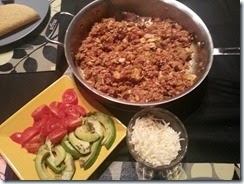
20131005_190446

Here’s the picadillo and the fixings.   Both of us enjoyed.

Criticism and Self-Cricitcism

After we both had praised the dish, Debbie added some criticism:

“You know, you couldn’t really taste the olives.”

“I know,” I said.  “I didn’t put enough of them in.”

“We ran out?  I thought we had that whole bag [a bag of pitted green olives we had around from something, vacuum sealed, etc.].”

“We did; we still have some.  But I scaled down the ingredients for fewer portions and then scaled them back up again but didn’t scale up the olives.”

She laughed.

“Why the hell not?”

“Too much work to slice them.”

Well, that’s the way it goes.  Laziness bring consequences.

Friday, October 4, 2013

Use Case #2: Geeks and Suits

Time to switch gears.

I know the most about entrepreneurs pitching business ideas to investors, because that’s what I’ve been doing for the past 10 years.

But prior to that I was a tech guy, and got a lot of experience (among other things) trying to get the managements of my companies to take on a new tech project, and watching my tech brothers and sisters do the same thing.

I want to turn to this use case next, and spend a few posts on special Solution Pitching angles to Geeks and Suits.

Of course, the fundamentals remain the same:

  1. Know what your audience is thinking
  2. Benefits Not Features
  3. Be Respectful

Onward and upward!